The Strike Was About a Number Nobody Had Yet
How the Writers Guild Spent 100 Days Arguing Over Revenue That Had Barely Arrived
Dates on this page
- October 2007
- 5 November 2007
- 12 February 2008
- 1988
- 2005
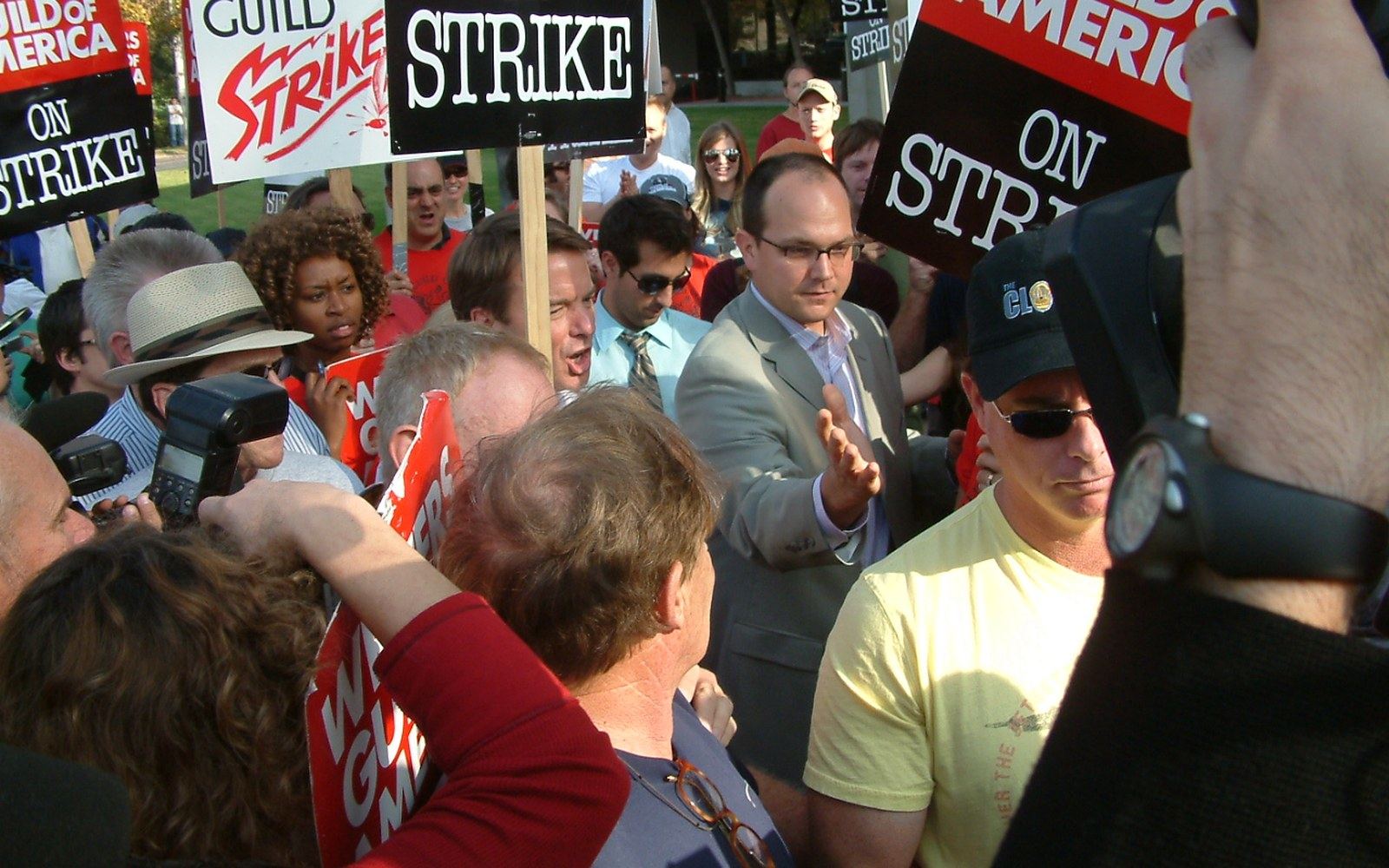
When the Writers Guild of America walked out on 5 November 2007, the central dispute was not over wages that anyone could measure. It was over residual payments for streaming — a distribution channel whose economics were, at the time, almost entirely theoretical. The existing contract, negotiated in 1988 at the tail end of the home-video boom, had set the residual formula for videocassettes at a fraction of what writers had originally sought. Nearly two decades later, the Alliance of Motion Picture and Television Producers intended to apply the same logic to the internet: treat streaming as a new and unproven medium, suppress the residual rate during an "ambiguous" period, and renegotiate later. The WGA had seen that argument before.
What Each Side Actually Said
The WGA's formal proposals, published in October 2007 before the strike began, asked for a residual on internet-distributed content pegged to the distributor's gross revenue rather than a nominal flat fee. The Guild also sought jurisdiction over content written specifically for the internet — webisodes, mobisodes and promotional material repackaged from produced scripts — which the AMPTP had categorised as promotional rather than compensable work. A third demand addressed new-media jurisdiction directly: the WGA wanted any content delivered online to fall under collective bargaining, regardless of the platform.
The AMPTP's counter-positions held that streaming revenue was too uncertain to support a percentage formula. Studios and networks argued that ad-supported and subscription streaming were not yet generating the kind of returns that warranted treating the internet as equivalent to broadcast or cable. The AMPTP proposed a two-year "study period" during which promotional streaming would carry no residual obligation at all. For paid downloads — the iTunes model that Apple had launched for television episodes in 2005 — the producers offered a residual calculated on a smaller slice of the transaction price than the WGA sought.
The WGA rejected the study period outright. Its public communications during the 100-day stoppage emphasised that the 1988 home-video precedent had locked writers into a disadvantageous formula for the entire VHS and DVD era. By accepting a suppressed rate during another "experimental" window, the Guild argued, writers would effectively surrender leverage for the life of whatever distribution model replaced the one then emerging.
The Settlement and What It Established
The strike ended on 12 February 2008 after 100 days. The settlement, ratified by WGA membership, established residuals for paid electronic sell-through — downloads sold at retail — at 1.2 percent of the distributor's gross after an initial window, stepping up over the contract's life. For ad-supported streaming, the formula used a flat payment per programme for the first year, moving to a percentage-of-revenue basis thereafter. The AMPTP's proposed study period was dropped.
Internet-made content remained a contested area. The final agreement extended Guild jurisdiction to original content produced for new media, but with a higher budget threshold than applied to traditional television — meaning lower-budget web productions could still be made outside the contract. The WGA characterised this as a partial win; the AMPTP accepted it as a workable boundary.

The economic cost of the stoppage was substantial. The Los Angeles County Economic Development Corporation estimated at the time that the strike cost the California economy roughly $380 million in its first month alone, a figure that accumulated across the full 100 days as late-night and scripted primetime shows exhausted banked episodes and networks pivoted to reality programming and reruns. The Bureau of Labor Statistics tracked the walkout among the major work stoppages of 2007–2008.
What the settlement could not do was fix a number. The streaming residual formulas agreed in February 2008 were written for a market in which Netflix was still primarily a DVD-by-mail service and YouTube had been owned by Google for barely a year. By the time those formulas had run through even one contract cycle, the revenue base they were meant to address had grown by orders of magnitude. The writers had fought for jurisdiction over a platform whose scale was still arriving. They got the jurisdiction. The argument about the number — what percentage of what — would return.