A Server, a Camera and the WTO
How a makeshift streaming operation in Seattle became the template for open-publishing news
Dates on this page
- 30 November 1999
- 3 December 1999
- 2000
- 2003
- October 2004
- Mid-to-late 2000s
Built for One Week, Running for Years
The Independent Media Center — universally known as Indymedia — opened its first server in a rented space in Seattle in late November 1999. The occasion was the Third Ministerial Conference of the World Trade Organization, scheduled to run from 30 November to 3 December. A coalition of activist technologists, documentary filmmakers and radical journalists assembled the operation specifically to cover protests that mainstream outlets, they argued, would filter through the interests of corporate ownership. What they built outlasted the conference by years and seeded a global publishing network that no single organisation controlled.
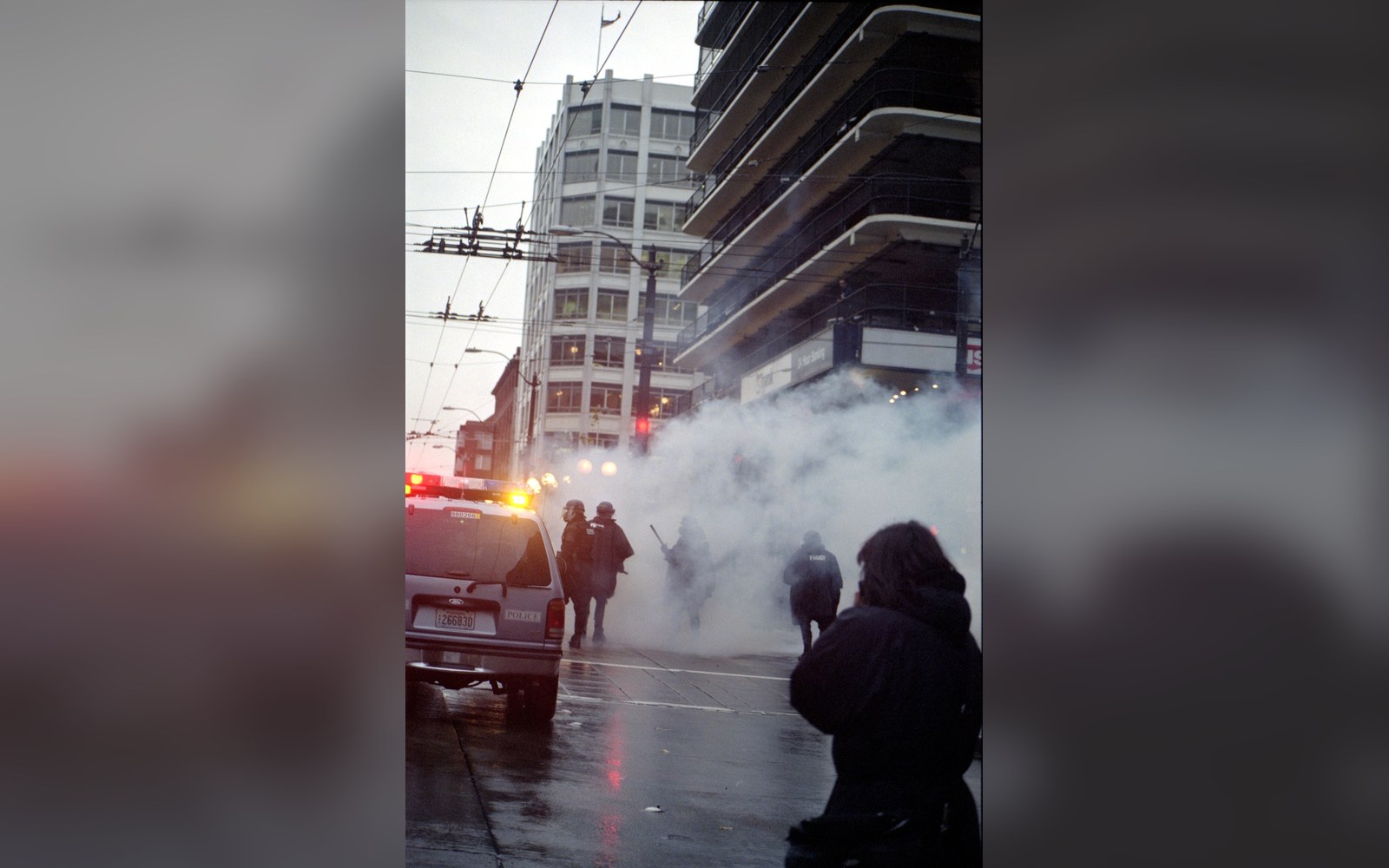
The technical foundation was an open-publishing platform called Active, developed by Australian programmers and adapted for the Seattle launch. Active allowed any registered user to post text, audio or video files directly to the front page without passing through an editor or moderator. The architecture was deliberately horizontal: there was no masthead, no assignment desk, no gatekeeper between a person on the street with a camera and a story appearing on the site. Indymedia's own documentation described the principle as "open publishing," distinguishing it from both traditional editorial hierarchies and the early blog format, which still centred individual voices rather than open collective submission. The first Seattle site streamed video from the streets during the days of protest that became known as the Battle of Seattle, when tear gas, rubber bullets and mass arrests produced footage that wire services were not positioned to capture in real time.
The Network Expands
Seattle demonstrated a replicable model. Within months of the WTO conference, independent media centres had opened in Washington D.C. and London, each running its own instance of the software, linked to a shared global newswire. The structure was federative rather than franchised: local centres set their own editorial policies within a loose global framework, and content aggregated upward to a central wire that all member sites could pull from. By 2003, more than 150 local Indymedia centres were operating across six continents, from Argentina and South Korea to Nigeria and Poland.
The expansion coincided with, and in part inspired, the wider open-source journalism conversation. Indymedia operated on software released under open licences, and its technical collective shared code freely. The network faced persistent problems that openness created: spam, disinformation and legally sensitive material appeared on the front page alongside genuine reporting, and local centres spent significant volunteer hours moderating after the fact rather than before. The model was philosophically committed to minimising prior restraint, which in practice meant the front page was frequently contested territory.

Funding came from reader donations, benefit events and occasional foundation grants — never from advertising. The absence of a revenue model that scaled meant that technical infrastructure remained fragile; server capacity was a recurring constraint even at the network's peak. When the FBI seized Indymedia servers in the United Kingdom in October 2004 — acting on a legal assistance request from Swiss and Italian authorities, the precise grounds of which were never fully disclosed — several local sites went dark for days, exposing how dependent the federated network remained on centralised hardware at key nodes.
What the Model Left Behind
Indymedia's open-publishing architecture predated the user-generated content platforms that would eventually absorb its audience. YouTube launched in 2005; by then Indymedia's traffic had already peaked. The network did not disappear cleanly: local centres closed in waves through the late 2000s and into the 2010s as volunteer energy dispersed and commercial platforms offered easier tools. What the Seattle experiment had demonstrated — that low-cost hardware and open software could replace a printing press or a broadcast licence as the barrier to entry for news — proved correct. The demonstration just arrived before the infrastructure existed to sustain it at scale, and before anyone had worked out what paying for it would look like.